How to Hold Your Crochet Hook and Yarn (for Even, Relaxed Stitches)
If your stitches are tight, uneven or your hand gets tired fast, the problem usually isn't the stitch. It's how you're holding things. A small change in grip can make crochet feel easier right away.
 Save
What You'll Learn
- The two common ways to hold a hook, and how to pick yours
- Simple ways to hold the yarn so your tension stays even
- What your other hand should be doing (it's busier than you think)
- How to keep your hands relaxed during longer projects
The two ways to hold a crochet hook
Most crocheters use one of two grips. Neither is better. Try both and keep the one that feels comfortable.
The pencil grip
Hold the hook the way you’d hold a pencil, between your thumb and index finger, with the handle resting on the top of your hand near your knuckle.
- Gives you fine control.
- Feels natural if you write a lot.
- Can tire your wrist on very long sessions.
The knife grip
Hold the hook like a knife you’re cutting with, with your hand over the top of the handle and your index finger resting along it.
- Feels sturdy and steady.
- Uses more of your arm, so your fingers don’t do all the work.
- Lovely for chunky yarns and bigger hooks.
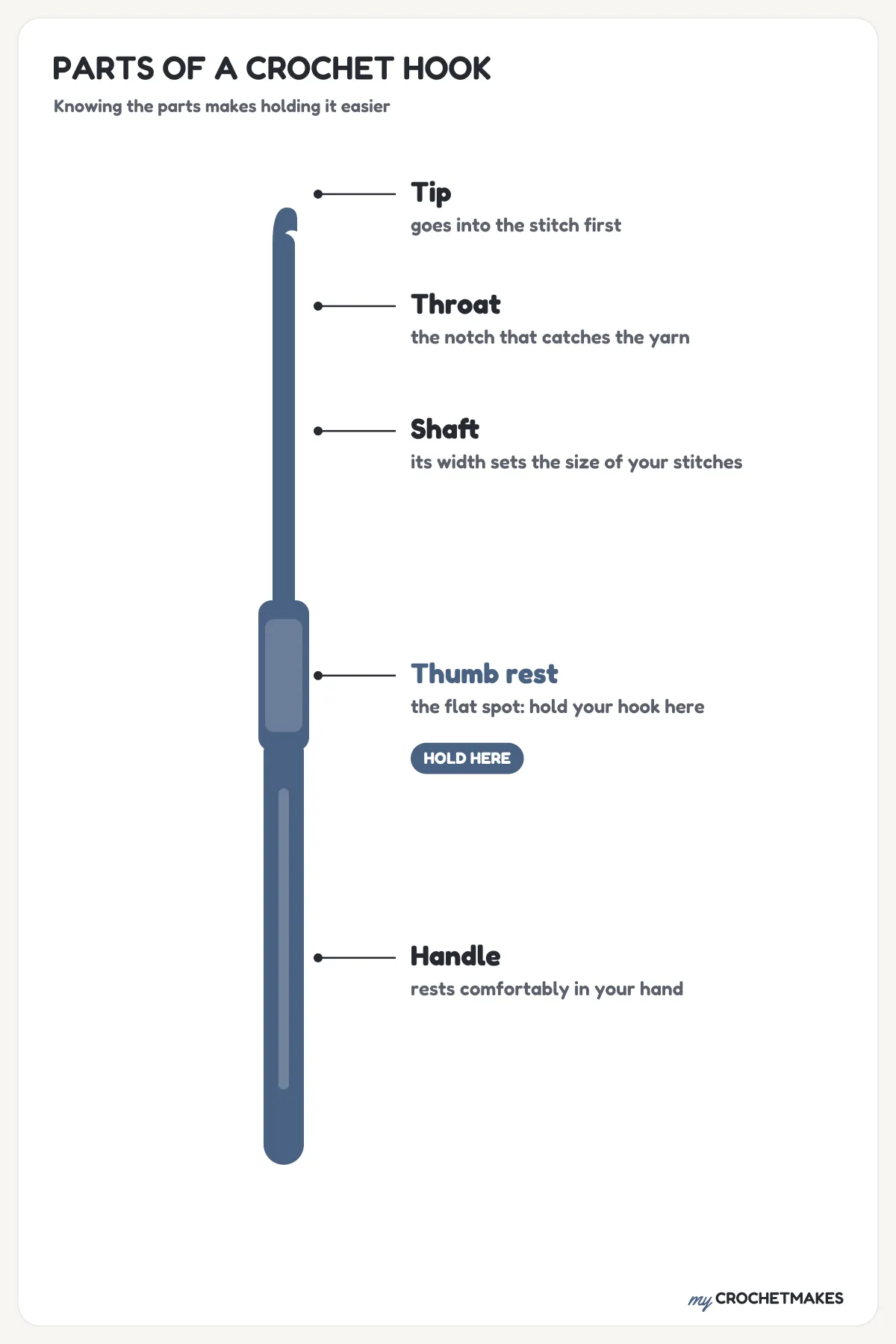
Whichever grip you choose, hold the hook at the thumb rest, the flat part in the middle. That’s what it’s there for.
How to hold your yarn
Your other hand has two jobs: feeding the yarn to the hook at a steady speed, and holding your work still.
An easy way to start
- Lay the working yarn (the end attached to the ball) over your index finger.
- Let it run down across your palm.
- Loosely close your last two fingers over it, so it slides through with a little friction.
Lift your index finger slightly. That raised finger is where your hook grabs the yarn. Now hold your work between your thumb and middle finger, just below the hook.
If the yarn slips too fast
Wrap it once around your pinky finger before it runs over your index finger. That extra wrap adds just enough drag to keep the yarn from flying through.
If the yarn feels too tight
Skip the pinky wrap, and let the yarn run more loosely across your palm. You want it to slide, not drag.
Signs your tension needs adjusting
Your stitches are so tight it’s hard to get the hook in. Relax your yarn hand, and pull up each loop a little taller.
Your fabric looks loose and loopy. Add the pinky wrap, or tuck the yarn under one more finger.
Your rows look uneven, some tight and some loose. That usually means you change grip or speed partway through. Try to keep the same rhythm, and don’t let go of the yarn between stitches.
Keep your hands happy
- Loosen up. If your knuckles are white, you’re squeezing too hard. A gentle grip is all you need.
- Take short breaks. Stretch your fingers and roll your wrists every half hour or so.
- Get comfortable. Most evenings I crochet on my living room sofa with a cup of tea. Find your own cozy spot, with good light and support for your back.
Give it a few rows
Any new grip feels strange at first. Make a practice row of chains, then a few rows of single crochet, and see how it feels by the end. If your stitches start to look more even, you’ve found your grip.
Frequently asked questions
Is there a right way to hold a crochet hook?
No. The pencil grip and the knife grip are both completely fine. Use whichever feels natural and lets you make even stitches.
What does "tension" mean in crochet?
Tension is how tightly the yarn feeds through your fingers as you work. Even tension gives you stitches that are all the same size.
Can I crochet left-handed?
Yes. Everything works the same way, just mirrored. You'll hold the hook in your left hand and work from left to right.
My hand hurts after crocheting. What can I do?
Loosen your grip, take short breaks, and stretch your fingers every half hour or so. A hook with a thicker, cushioned handle can help a lot too.