Free Spike Stitch Granny Stripe Blanket Crochet Pattern
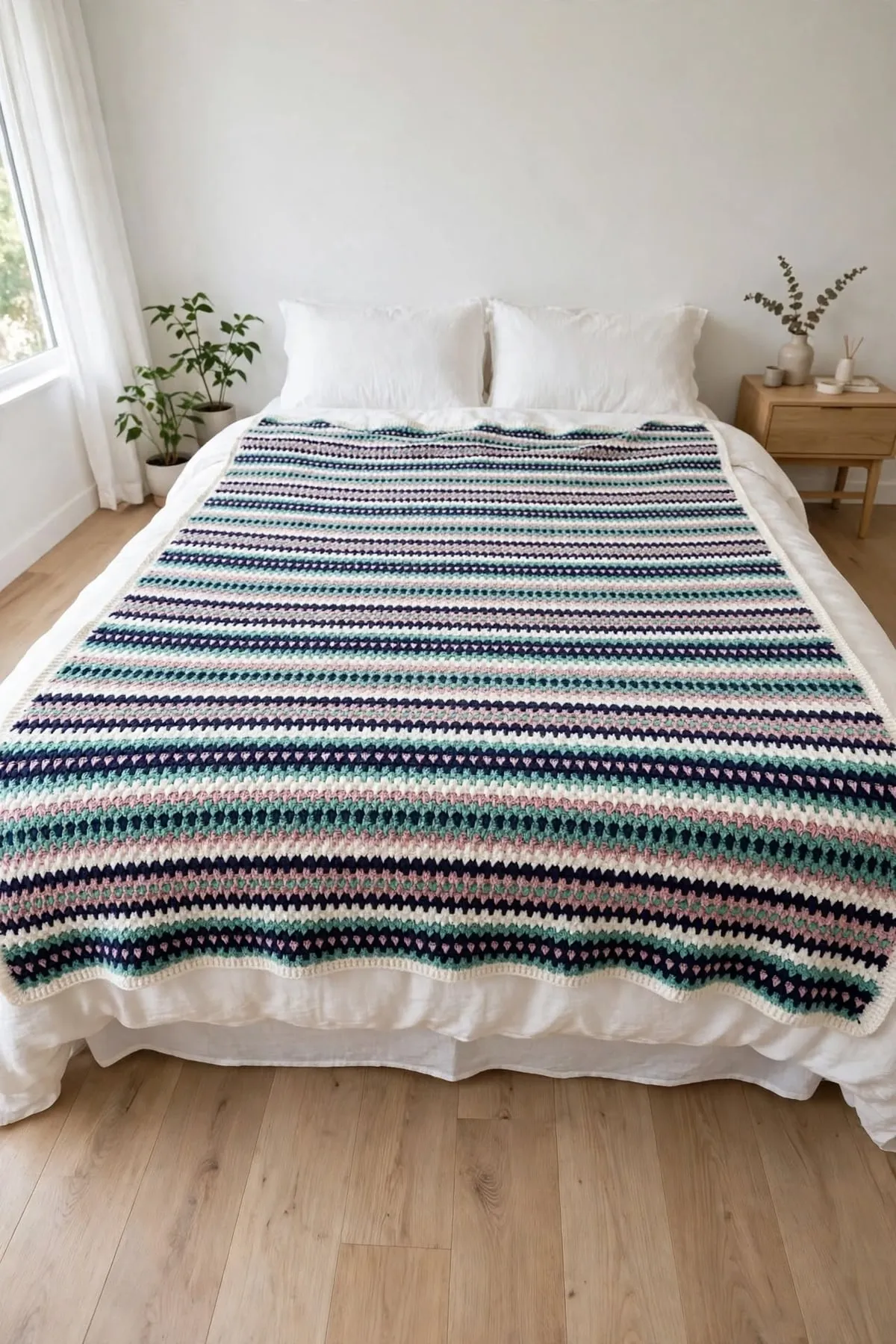
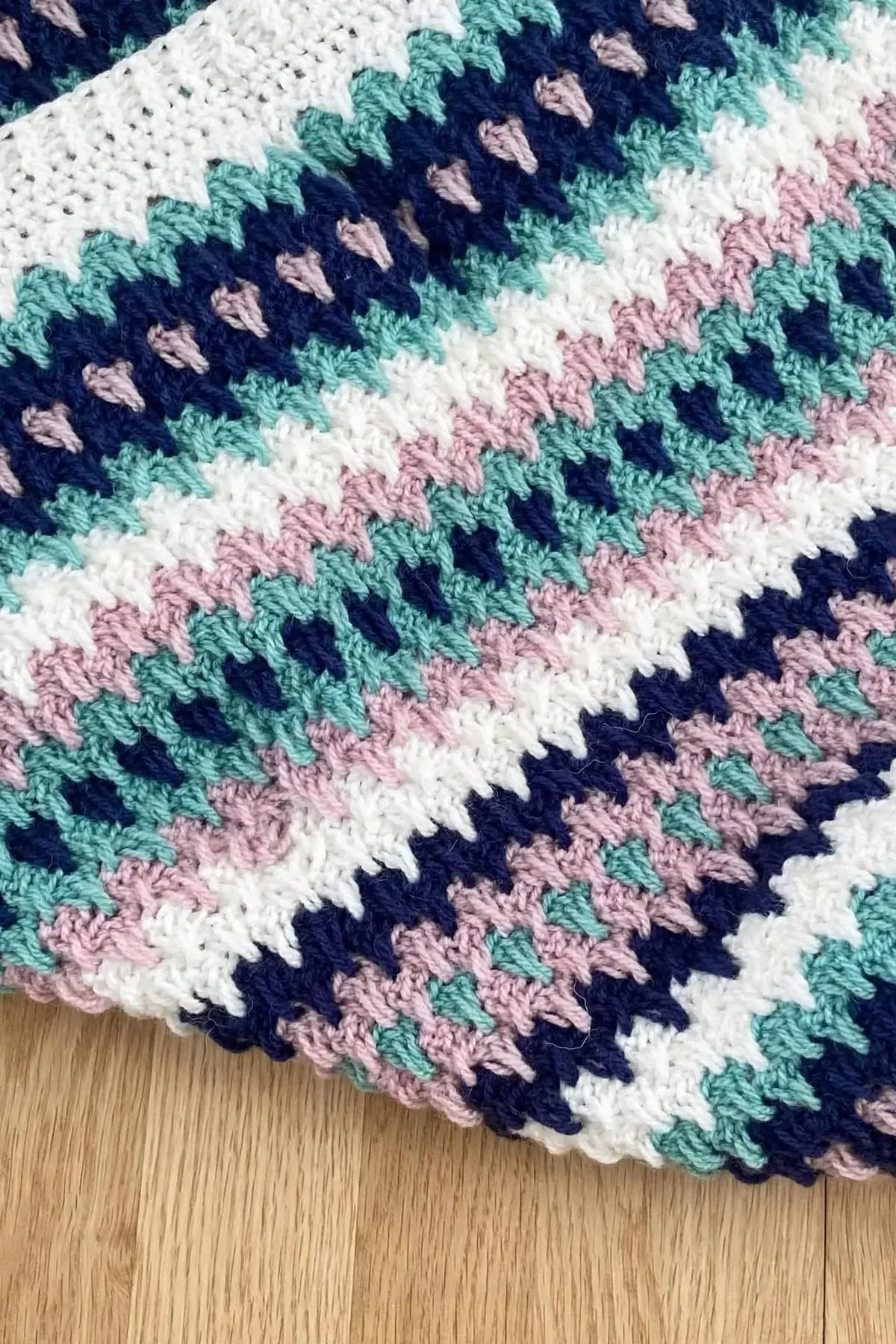
This cozy blanket takes classic granny stripes and adds a twist. On every second row, the middle stitch of each cluster dips down into the rows below, leaving a little spike of color. In navy, teal, mauve and white, it looks bold and modern but stays easy to make.
 Save
Pattern Highlights
- It's a two-row repeat, so it's easy to memorize.
- The spike stitches add a pop of color to every stripe, with no extra pieces.
- The rows work up quickly in DK yarn, and the blanket has a lovely drape.
- Every row has a stitch count, so you can check as you go.
Materials
- Light (#3) DK yarn in 4 colors: white, mauve pink, teal and navy
- 4 mm (G-6) crochet hook
- Yarn needle
Abbreviations used
This pattern uses US crochet terms. Tap any abbreviation for a full explanation, or see the complete crochet abbreviations list.
About this blanket
This blanket is worked in rows from the bottom up. After a starting row of single crochet, it’s a simple two-row repeat: a plain granny row, then a spike row. Each 2-row stripe is a new color, so the spikes pull a little of every new color down into the stripe below.
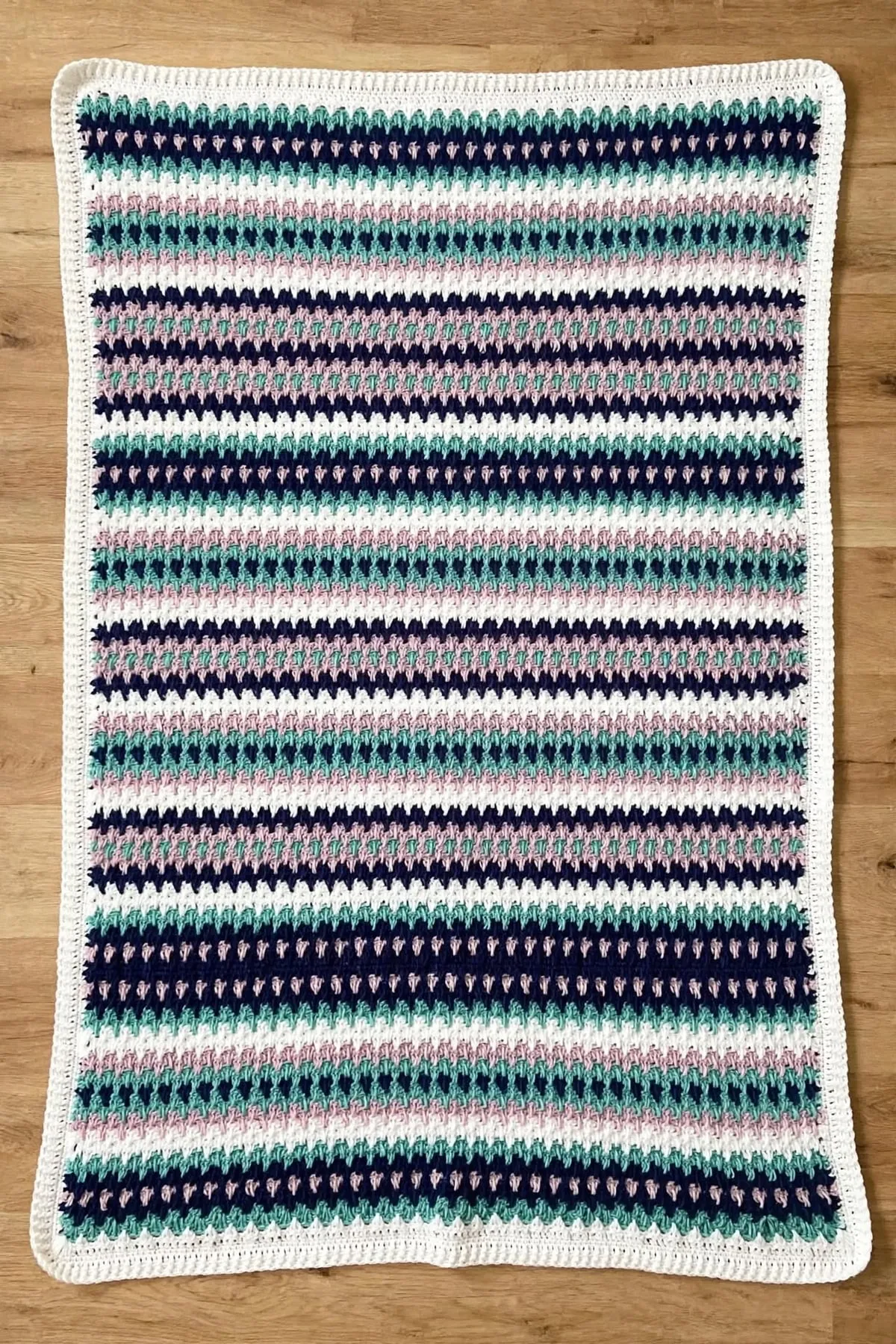
You’ll need four colors of DK yarn: white, mauve pink, teal and navy.
Before you start
This one is rated easy. It’s chains, single crochet and double crochet, plus one special stitch, the spike dc, which is just a dc worked lower down.
- It’s worked in rows. Turn at the end of every row.
- Learn the granny stripe first. Clusters of 3 dc always go into the spaces between the clusters of the row below.
- Count your first rows. Even rows have 139 stitches and odd rows have 140. Once those match, the rest is easy.
How the spike stitch works
On every spike row, each cluster is (dc, spike dc, dc). The two outer dc go into the space as usual. The middle one, the spike, reaches down into the row 2 rows below before you finish it.
Because you’re working the spike in the new stripe’s color, it lays a little line of that color over the stripe below. Pull the loop up long and loose, to the height of the row you’re on, so the fabric stays flat.
Tips for success
- Keep your foundation chain loose. A tight chain makes a narrow bottom edge. A bigger hook just for the chain helps.
- Crochet over your tails. With 50 stripes, there are lots of ends. Working over them as you go saves a lot of time.
- Check the edges. Every row should start with ch 3 and end in the top of the turning chain, so the sides stay straight.
- Block it. A light mist of water and a day drying flat helps the spikes and the rope edge settle beautifully.
Skills you’ll use
- How to make a slip knot and chain, for the foundation chain
- How to single crochet, for the first and last rows and the border
- How to double crochet, for every cluster and spike
- How to weave in ends, for all those stripes
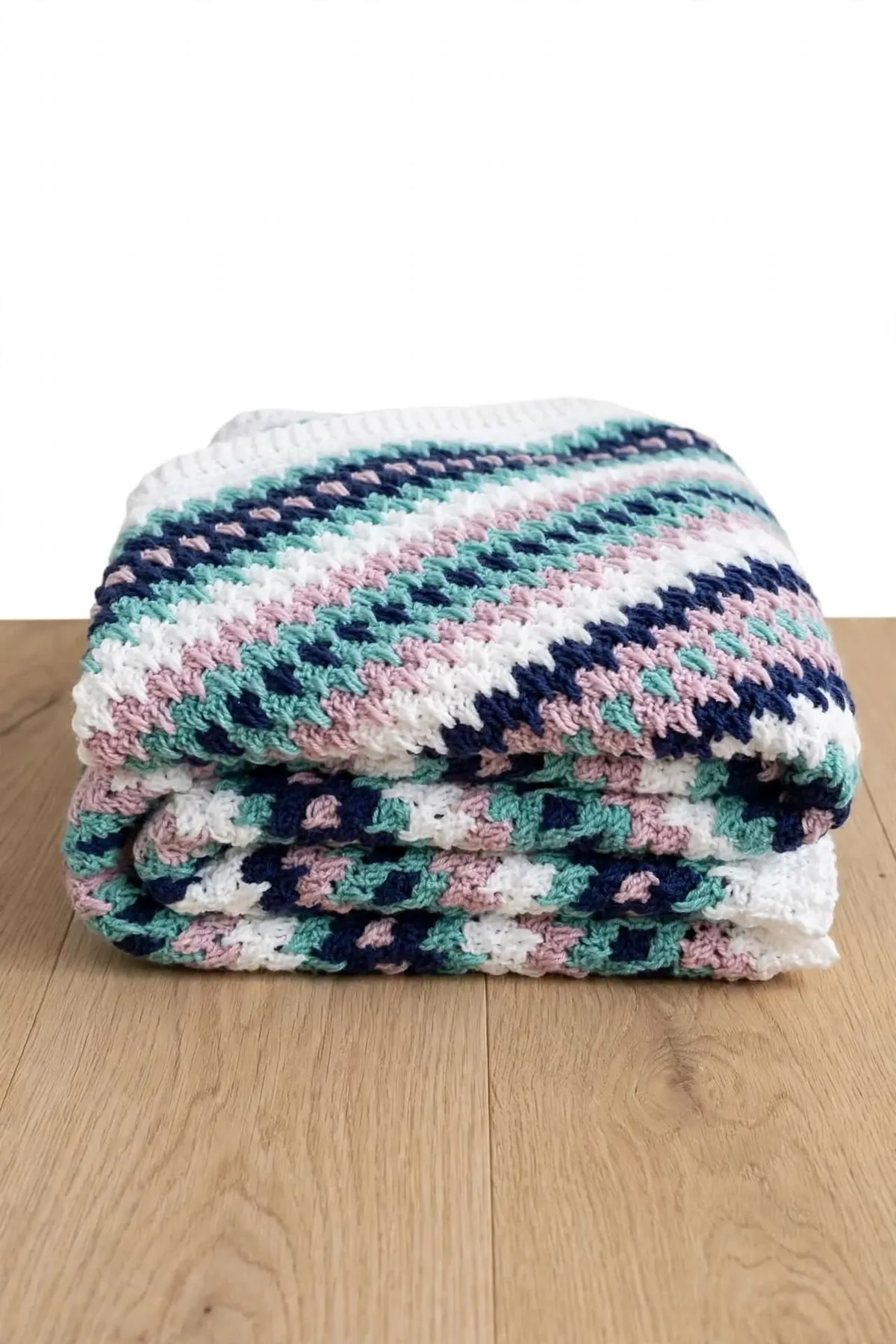
A striped blanket like this looks lovely on a bed or folded over the back of a sofa, and it makes a wonderful handmade gift. 🧶
The Pattern
- Skill level
- Easy
- Yarn
- Light (#3) DK yarn
- Yarn amount
- About 2,000 yd (1,830 m) in total: about 2 balls (300 yd / 100 g each) of each color, plus an extra ball of white for the border. These are estimates.
- Hook
- 4 mm (US G-6)
- Gauge
- About 5 clusters across and 9 rows = 4 in (10 cm). Not critical for a blanket.
- Finished size
- About 39 x 47 in (99 x 119 cm) with the border (an estimate; it depends on your yarn and tension)
- Time
- Varies with experience
Blanket
- With white, ch 140.
- Row 1: Sc in 2nd ch from hook and in each ch across. Turn. (139 sc)
- Row 2: Ch 3 (counts as a dc), dc in first sc. [Skip next 2 sc, 3 dc in next sc] 45 times, skip next 2 sc, 2 dc in last sc. Turn. (139 sts: 45 clusters with a half cluster at each end)
- Row 3: Spike row. Ch 3 (counts as a dc), skip next dc. [(Dc, spike dc, dc) in next sp between clusters] 46 times, dc in top of turning ch. Turn. (140 sts: 46 clusters) In this row only, take each spike dc down into row 1, into the second of the 2 sc that were skipped below it.
- Row 4: Ch 3 (counts as a dc), dc in first st. [3 dc in next sp between clusters] 45 times, 2 dc in top of turning ch. Turn. (139 sts)
- Row 5: Spike row. Ch 3 (counts as a dc), skip next dc. [(Dc, spike dc, dc) in next sp between clusters] 46 times, dc in top of turning ch. Turn. (140 sts) From now on, take each spike dc down into the top of the spike dc 2 rows below.
- Rows 6–101: Repeat rows 4 and 5, changing colors every 2 rows as shown in the stripe order below. (Even rows 139 sts, odd rows 140 sts)
- Row 102: With white, ch 1, sc in each st across. (140 sc) Don't fasten off. Go straight on to the border.
Stripe order
- Each stripe is 2 rows: a plain row, then a spike row. To change color, work the last dc of the row before until 2 loops are left on your hook, then pull the new color through.
- Rows 2–3: White.
- Rows 4–5: Mauve.
- Rows 6–7: Teal.
- Rows 8–9: Navy.
- Rows 10–11: Mauve.
- Rows 12–13: White.
- Rows 14–15: Teal.
- Rows 16–17: Navy.
- Rows 18–19: Teal.
- Rows 20–21: Mauve.
- Rows 22–23: White.
- Rows 24–25: Mauve.
- Rows 26–27: Teal.
- Rows 28–29: Navy.
- Rows 30–31: Mauve.
- Rows 32–33: White.
- Rows 34–35: Teal.
- Rows 36–37: Navy.
- Rows 38–39: Teal.
- Rows 40–41: Mauve.
- Rows 42–43: White.
- Rows 44–45: Mauve.
- Rows 46–47: Teal.
- Rows 48–49: Navy.
- Rows 50–51: Mauve.
- Rows 52–53: White.
- Rows 54–55: Teal.
- Rows 56–57: Navy.
- Rows 58–59: Teal.
- Rows 60–61: Mauve.
- Rows 62–63: White.
- Rows 64–65: Mauve.
- Rows 66–67: Teal.
- Rows 68–69: Navy.
- Rows 70–71: Mauve.
- Rows 72–73: White.
- Rows 74–75: Teal.
- Rows 76–77: Navy.
- Rows 78–79: Teal.
- Rows 80–81: Mauve.
- Rows 82–83: White.
- Rows 84–85: Mauve.
- Rows 86–87: Teal.
- Rows 88–89: Navy.
- Rows 90–91: Mauve.
- Rows 92–93: White.
- Rows 94–95: Teal.
- Rows 96–97: Navy.
- Rows 98–99: Teal.
- Rows 100–101: Mauve.
Border (white)
- Round 1: Ch 1. Along the top edge, (sc, ch 2, sc) in the first st, sc in the next 138 sts, (sc, ch 2, sc) in the last st. Down the side, 1 sc in the end of each sc row and 2 sc in the end of each dc row (202 sc). Along the bottom (the foundation chain), (sc, ch 2, sc) in the first ch, sc in the next 137 ch, (sc, ch 2, sc) in the last ch. Up the other side, 202 sc as before. Join with a sl st to the first sc. (687 sc and 4 corner ch-2 sps)
- Round 2: Ch 3 (counts as a dc), dc in each sc around, working (2 dc, ch 2, 2 dc) in each corner ch-2 sp. Join with a sl st to the top of the beg ch 3. (703 dc)
- Round 3: Rope edge. Ch 1. Working from left to right, reverse sc in each dc around, and 2 reverse sc in each corner ch-2 sp. Join with a sl st to the first st and fasten off. (711 sts)
- Weave in all the ends. Lay the blanket flat, pin it to shape, mist it lightly with water and let it dry.
Pattern notes
- Spike dc: yarn over, insert the hook into the stitch indicated 2 rows below, yarn over and pull up a long loop to the height of the current row, then finish like a normal dc.
- Reverse sc (rope edge): work single crochet from left to right instead of right to left. It makes a twisted, rope-like edge.
- The ch 3 at the start of each row counts as a dc. End every row with a stitch in the top of the turning chain.
Keep this pattern handy
Print it now, or get the free PDF to save on your phone or tablet.
Free Spike Stitch Granny Stripe Blanket Crochet Pattern · Pattern by mycrochetmakes · mycrochetmakes.com/spike-stitch-granny-stripe-blanket-crochet-pattern/
Free for personal use. Please don't sell or redistribute this pattern.
Frequently asked questions
What is a spike stitch?
It's a stitch worked into a row further down instead of the row just below. Here, the middle dc of each cluster reaches down 2 rows, so a little stripe of the new color shows over the color below.
My spikes look tight and pull the fabric. What can I do?
Pull up the loop for the spike nice and long, to the height of the row you're working, before you finish the dc. That keeps the fabric flat.
Can I make it bigger or smaller?
Yes. Start with any chain that's a multiple of 3, plus 2. Then work more or fewer stripes for the length. Adjust the cluster counts in each row to match.
Do I cut the yarn at every color change?
Yes, since each stripe is only 2 rows. Crochet over the tails for a few stitches as you go, and there's much less weaving in at the end.
What yarn should I use?
Any soft DK (#3) yarn, in acrylic, wool or cotton. Acrylic is easy to wash and great for everyday blankets.