Free Sunset Chevron C2C Crochet Shawl Pattern
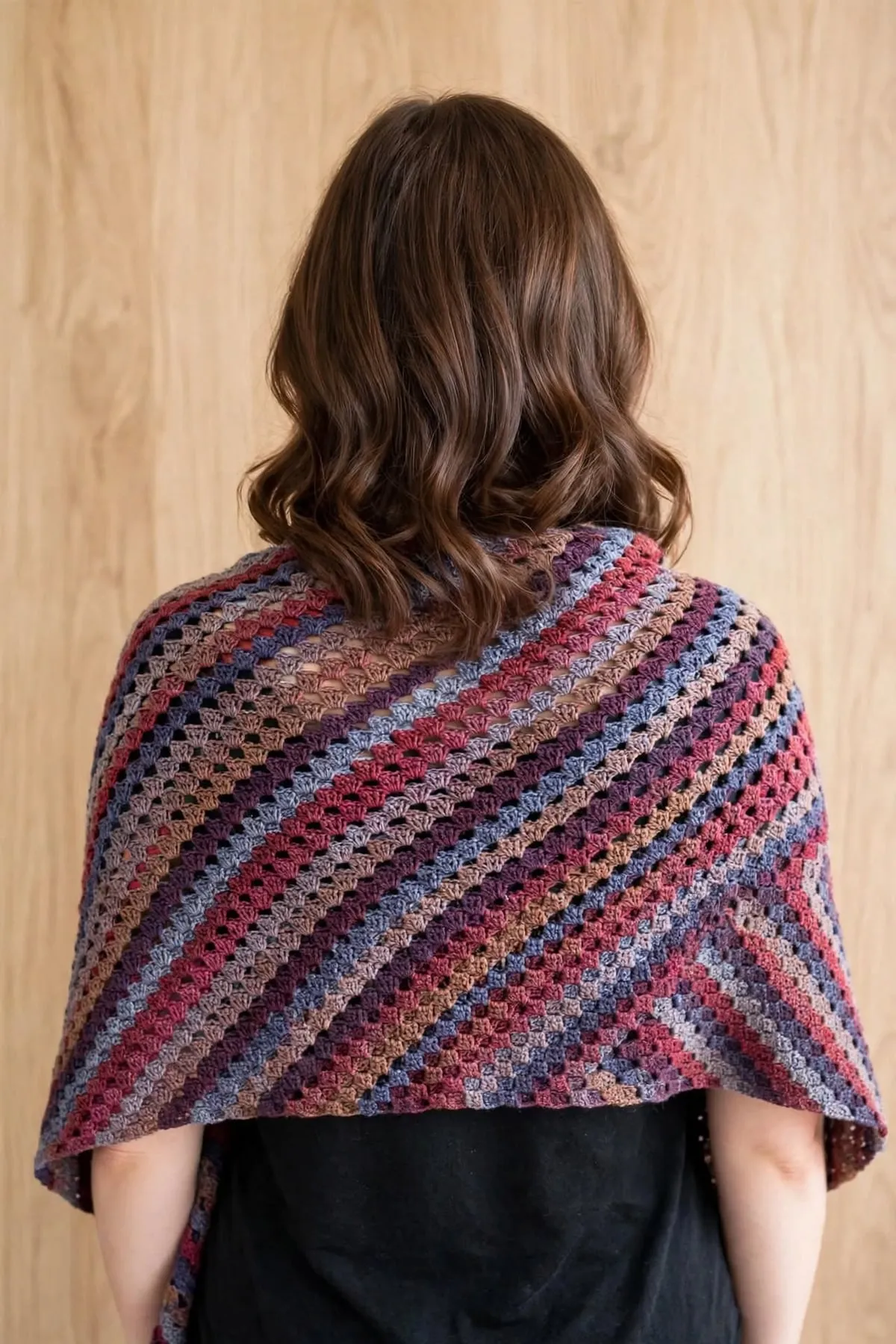
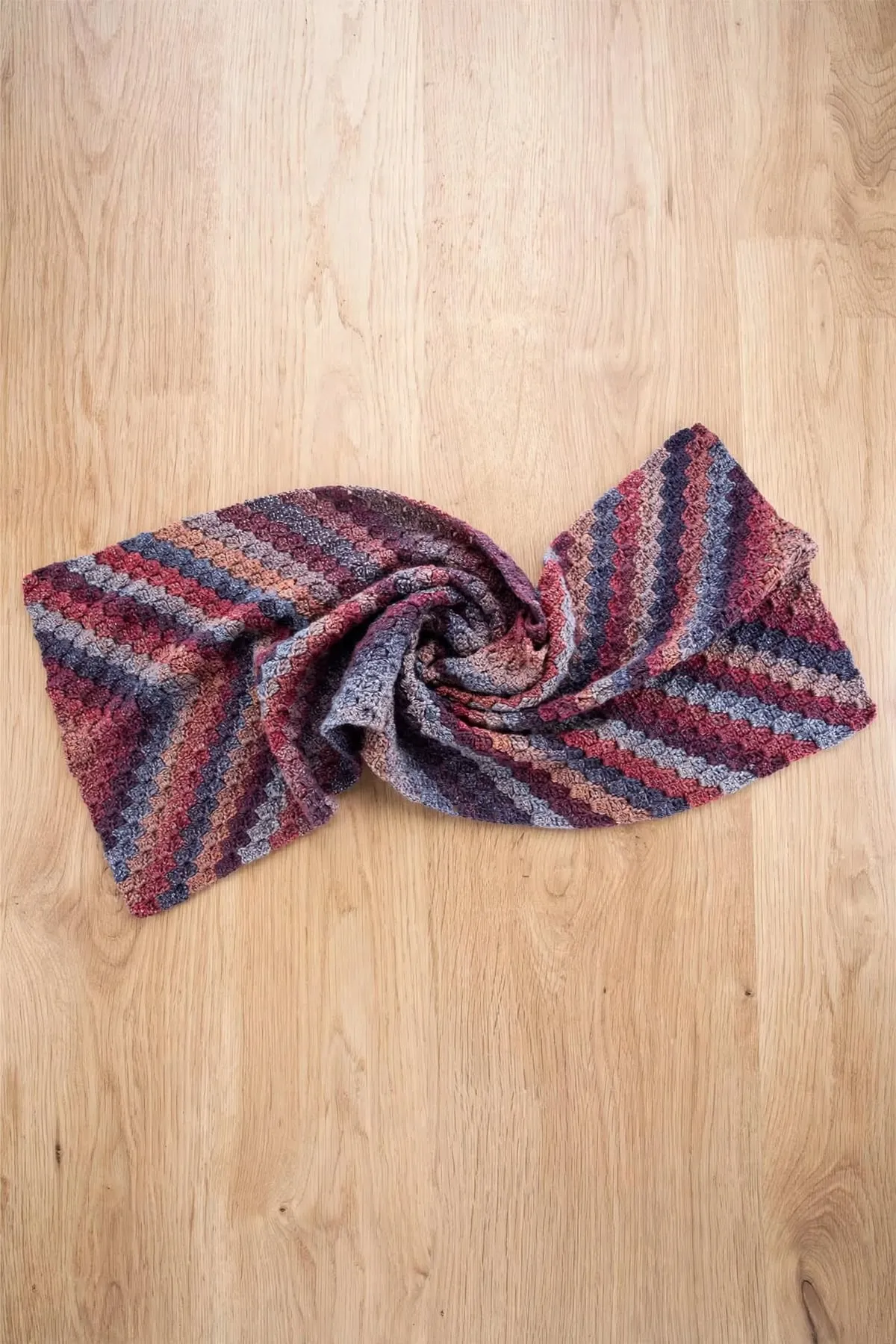
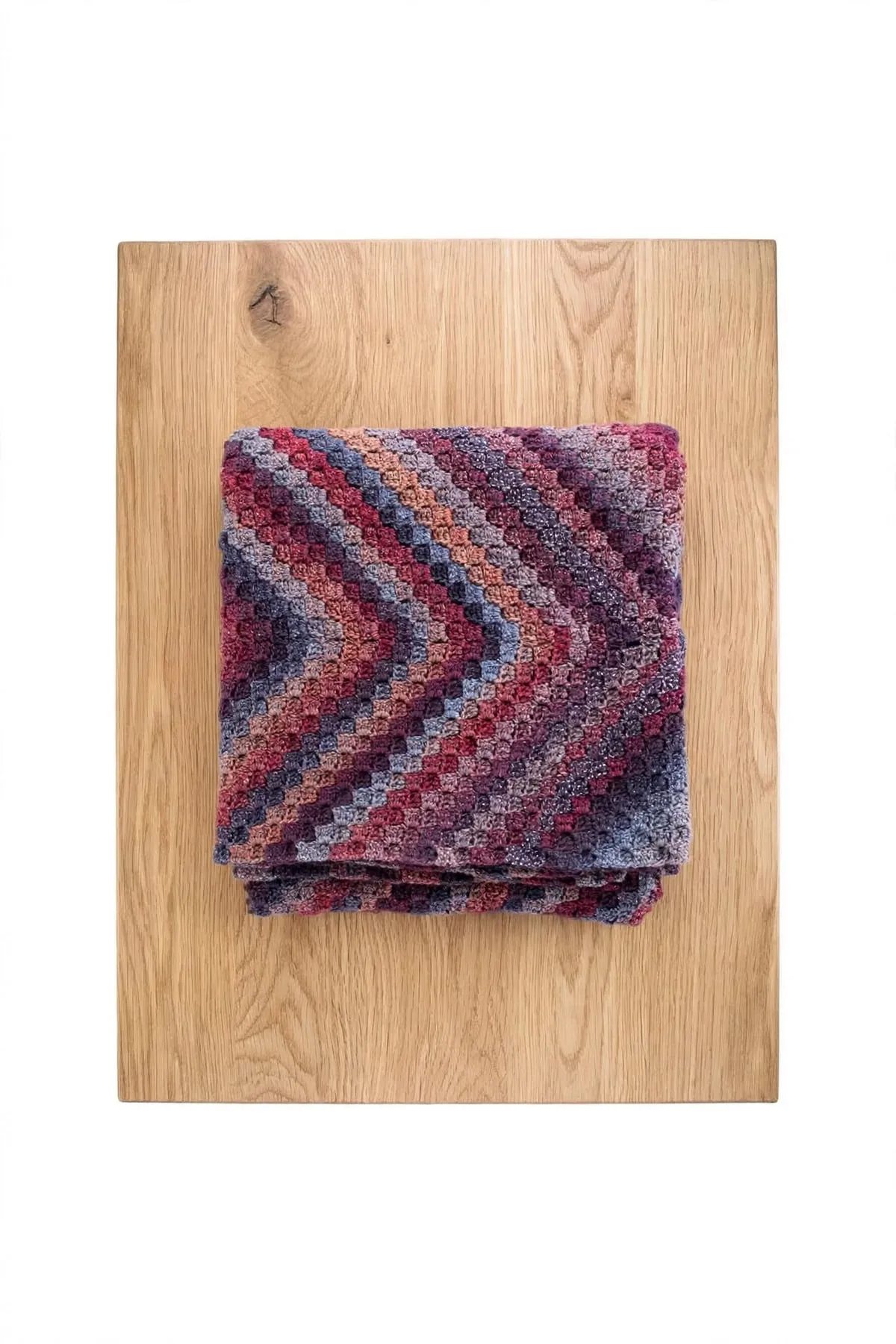
This cozy shawl is made in easy corner-to-corner blocks with a self-striping yarn. You make two matching rectangles, then join them so the diagonal stripes meet in a big chevron, ready to wrap around your shoulders.
 Save
Pattern Highlights
- Corner-to-corner blocks are just chains and double crochet.
- Self-striping yarn makes all the color changes for you.
- Both halves are the same, which makes it easy to remember.
- The chevron shows up like magic when you join the halves.
Materials
- About 700 yd (640 m) worsted (#4) self-striping yarn
- 5.5 mm (I-9) crochet hook
- Stitch markers
- Yarn needle
Abbreviations used
This pattern uses US crochet terms. Tap any abbreviation for a full explanation, or see the complete crochet abbreviations list.
About this shawl
This shawl is made from two rectangles of corner-to-corner blocks. Each half starts with one block in a corner and grows on the diagonal until it’s 16 blocks wide. Then one edge keeps growing while the other stays straight, which turns the triangle into a long rectangle. Finally both edges shrink until you’re back to one block in the opposite corner.
With a self-striping yarn, every diagonal row comes out a different color. When you flip one half over and join the short ends, the stripes meet in a big chevron.
Before you start
This one is rated easy. You only need chains, slip stitches and double crochet.
- Count your blocks. Count the blocks at the end of each row, especially while you’re increasing and decreasing.
- Mark the growing edge. In the middle section, a stitch marker on the edge that keeps growing helps you remember which end to increase on.
- Start both halves the same. If you can, start both halves at the same point in the yarn’s color sequence.
How the blocks work
A block is just 3 double crochet. To add a block, you start the row with ch 6 and 3 dc in the chain. To carry on across the row, you slip stitch into the ch-3 space of the next block below and work ch 3 and 3 dc there. To take a block away, you slip stitch past the first block at the start, or stop at the last block without working into it. That’s all there is to it!
Tips for success
- Keep your blocks even. Pull up the ch 3 snugly so each block is the same size.
- Watch the edges. Neat increases and decreases make straight, tidy sides.
- Block it. Pin each half flat and spray it lightly with water before joining. The edges will line up much better.
- Join from the right side. That way you can see the stripes meet in the V as you sew.
Skills you’ll use
- How to make a slip knot and chain, to start each block
- How to double crochet, for every block
- How to single crochet, for the optional edging
- How to weave in ends, to finish neatly
A cozy, colorful wrap for chilly evenings, and a great way to learn corner-to-corner. 🧶
The Pattern
- Skill level
- Easy
- Yarn
- Worsted (#4) self-striping yarn
- Yarn amount
- About 700 yd (640 m). This is an estimate, so buy a little extra.
- Hook
- 5.5 mm (US I-9)
- Gauge
- 4 blocks = 5 in (13 cm), measured along a side edge
- Finished size
- About 20 in (51 cm) wide and 70 in (178 cm) long
- Time
- Varies with experience
Half (make 2)
- Row 1: Ch 6. 1 dc in the 4th ch from the hook and in each of the next 2 ch. Turn. (1 block)
- Row 2: Ch 6. 1 dc in the 4th ch from the hook and in each of the next 2 ch (a new block). Sl st into the ch-3 sp of the block below, ch 3, 3 dc in the same sp. Turn. (2 blocks)
- Rows 3–16: These are increase rows. Ch 6, 1 dc in the 4th ch from the hook and in each of the next 2 ch. Then [sl st into the next ch-3 sp, ch 3, 3 dc in the same sp] in every block across. Turn. Each row has one more block than the last, so Row 16 has 16 blocks.
- Place a marker on the edge where Row 17 will start. That edge keeps growing, and the other edge now stays straight.
- Rows 17–28: These rows keep 16 blocks. On rows 17, 19, 21, 23, 25 and 27, make the new block at the start as in an increase row, work blocks across, then sl st into the last ch-3 sp and turn without making a block there. On rows 18, 20, 22, 24, 26 and 28, sl st across the first 3 dc and into the first ch-3 sp, ch 3, 3 dc in that sp, then work a block in every ch-3 sp to the end. Turn. (16 blocks)
- Rows 29–43: These are decrease rows. Sl st across the first 3 dc and into the first ch-3 sp, ch 3, 3 dc in that sp, work blocks across, then sl st into the last ch-3 sp and turn without making a block there. Each row has one less block, so Row 43 has 1 block. Fasten off.
- The half measures about 20 in (51 cm) by 35 in (89 cm). Make a second half the same way.
Joining
- Lay both halves flat with their short ends touching. Turn the second half over, so its stripes slant the other way and the two halves make a V.
- Sew the short ends together with a whip stitch or mattress stitch, matching the blocks as you go.
- Optional edging: join the yarn at any corner and work a round of sc evenly around the whole shawl, with 3 sc in each corner. Join and fasten off.
- Weave in all the ends and block the shawl flat.
Pattern notes
- A block is 3 dc worked into a ch-3 space (or the ch-3 that starts a new block). Every row is a diagonal line of blocks.
- Increase: start the row with ch 6 and 3 dc, which adds a block. Decrease: start the row by sl st across the first block, or end it with a sl st in the last ch-3 sp without making a block.
- The two halves are the same. Flipping one over before you join them is what makes the chevron.
Keep this pattern handy
Print it now, or get the free PDF to save on your phone or tablet.
Free Sunset Chevron C2C Crochet Shawl Pattern · Pattern by mycrochetmakes · mycrochetmakes.com/c2c-chevron-crochet-shawl-pattern/
Free for personal use. Please don't sell or redistribute this pattern.
Frequently asked questions
What is corner-to-corner crochet?
It's a way of crocheting little blocks of 3 double crochet on the diagonal, starting from one corner. Each row adds or removes a block, so the piece grows and shrinks on the diagonal.
What yarn should I use?
A worsted (#4) self-striping or gradient yarn with long color changes looks best, since each stripe covers a whole diagonal row. A solid yarn works too and shows off the block texture.
How do I make it wider or longer?
For a wider shawl, keep increasing past 16 blocks before you start the straight section. For a longer one, work more rows in the straight section. Both halves need the same changes.
My stripes don't line up at the join. Is that okay?
Yes! Self-striping yarn never repeats perfectly. If you'd like the stripes to match better, start both halves at the same point in the color sequence.
How do I wear it?
Drape it over your shoulders like a wrap, wear it as a long scarf, or fold it in half lengthwise for a cozier fit.